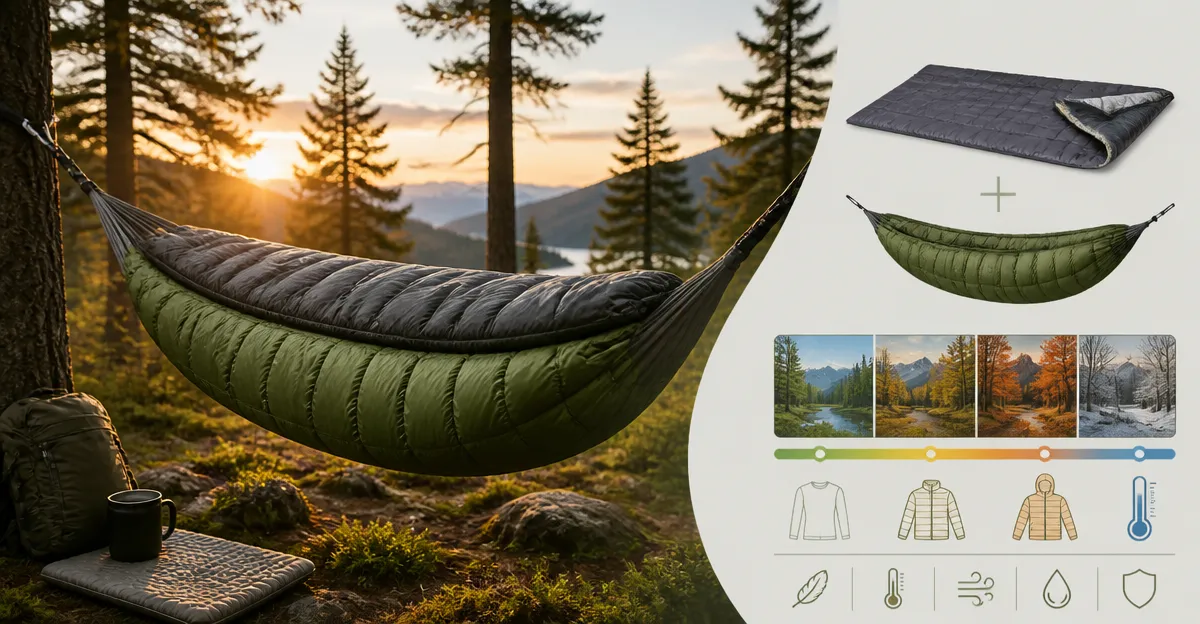
Top Quilt + Underquilt Mixing Guide for Transitional Seasons: Layering Tips for Spring & Fall Hammock Camping
Introduction
Transitional seasons present a unique challenge for hammock enthusiasts. Temperatures can swing dramatically between day and night, and wind or humidity may affect comfort levels. This guide explains how to combine quilts and underquilts to create a versatile insulation system that adapts to changing conditions. Readers will learn foundational concepts, product recommendations, a detailed comparison chart, and actionable best‑practice tips.
By the end of the article, one will understand how to select the appropriate layers, mix and match items for specific weather scenarios, and avoid common pitfalls that lead to cold‑soaked nights. The information is grounded in real product data from Amazon, ensuring that recommendations are both practical and verifiable.
Background / Context
Hammock camping relies on three primary insulation components: the hammock fabric, an underquilt that hangs beneath the hammock, and a top quilt or sleeping bag that covers the camper. In spring and fall, the temperature range typically falls between 40°F and 65°F, a regime that can be managed with a lightweight underquilt paired with a moderate‑weight top quilt.
An underquilt functions like a blanket suspended beneath the hammock, trapping warm air that rises from the sleeper’s body. A top quilt, sometimes called a “top‑quilt” or “sleeping quilt,” provides additional warmth from above while allowing ventilation when needed. Understanding the thermal properties of each layer—such as fill type, insulation rating, and fabric weight—is essential for effective layering.
Key terms that will appear throughout this guide include:
- Fill Power: A measure of down or synthetic loft; higher numbers indicate greater warmth‑to‑weight efficiency.
- R-value: The thermal resistance of a material; higher values retain more heat.
- Water‑Resistance (WR): The ability of the outer fabric to repel moisture, crucial for damp mornings.
These concepts will be applied when evaluating the featured products.
Understanding Seasonal Temperature Shifts
Spring and fall often feature warm daytime sunshine followed by cool evenings. The diurnal temperature swing can be as much as 20°F, meaning a camper may need to shed or add insulation within a single night. Wind chill further reduces perceived temperature, especially in open campsites.
To manage these fluctuations, a modular system that separates the under‑quilt and top‑quilt is preferred. This arrangement allows the camper to remove the top quilt when the sun rises, while the underquilt continues to provide a baseline level of warmth throughout the night.
Strategic placement of the underquilt—centered beneath the hammock’s lowest point—maximizes the air pocket that retains heat. The top quilt should be sized to cover the sleeper’s shoulders and hips without excessive bulk, enabling easy adjustment.
By mastering these principles, one can stay comfortable without carrying excessive weight.
Core Principles of Layering for Hammock Camping
Effective layering follows three core principles: base, insulation, and protection. The hammock fabric itself acts as the base layer, providing a breathable platform. The underquilt serves as the primary insulation layer, while the top quilt offers secondary insulation and protection from wind and rain.
When selecting items, consider the following:
- Weight vs. Warmth: For transitional seasons, aim for a balance where the combined weight does not exceed 1.5 lb per person.
- Packability: Items should compress to a small volume to fit within a standard backpack.
- Versatility: Choose products that can be used independently (e.g., an underquilt as a standalone blanket).
Applying these criteria will guide the selection of the products described below.
Selecting the Right Underquilt
The underquilt is the cornerstone of any spring‑fall system. Below are four highly rated options, each with distinct attributes that make them suitable for specific scenarios.
The first recommendation, OneTigris Hammock Underquilt, offers a full‑length design that provides consistent coverage across the entire hammock. Its lightweight synthetic fill is rated for four‑season use, making it an excellent all‑rounder for unpredictable weather.
The Wise Owl Hammock Underquilt distinguishes itself with ultralight construction and water‑resistant fabric, ideal for hikers who prioritize minimal pack weight without sacrificing durability.
The AYAMAYA Hammock Underquilt features a double‑layer design that enhances insulation for colder nights while still remaining compact enough for spring trips.
Finally, the Onewind Full Length Hammock Underquilt incorporates Sorona insulation, a recycled‑nylon based material that offers a high R‑value while maintaining a low environmental footprint.
Choosing a Complementary Quilt
While an underquilt handles the bulk of nighttime heat retention, a top quilt adds flexibility for warmer daytime conditions. The OneTigris Featherlite Sleeping Quilt provides a lightweight, 35‑ounce solution rated for temperatures as low as 40°F. Its integrated footbox helps trap heat around the legs, a feature that can be especially useful in early spring when ground temperatures are still low.
When pairing a top quilt with an underquilt, consider the combined temperature rating. For example, the Featherlite Sleeping Quilt paired with the OneTigris Underquilt comfortably covers the 45°F‑60°F range, while the Wise Owl Underquilt combined with the same top quilt can handle slightly cooler nights down to 40°F.
Choosing a quilt with a breathable fabric, such as nylon ripstop, ensures that moisture can escape, reducing the risk of condensation inside the hammock.
In addition to the Featherlite, many campers repurpose a lightweight down sleeping bag as a top quilt, but the dedicated hammock‑specific design of the Featherlite offers better fit and less bulk.
Mixing and Matching: Building a Flexible System
To create a system that adapts to both cool evenings and warm mornings, follow these steps:
- Attach the underquilt using the hammock’s suspension lines, positioning it directly beneath the lowest point of the hammock.
- Secure the top quilt with a simple clip or carabiner to the hammock’s side straps, allowing quick removal.
- During the day, detach the top quilt and roll the underquilt into a compact bundle for daytime hikes.
- At night, re‑attach the top quilt and adjust the underquilt’s tension to eliminate any air gaps.
For added versatility, consider using a bivy sack over the top quilt on particularly windy evenings. The bivy adds a wind‑proof layer without significantly increasing weight.
When traveling in groups, sharing a larger underquilt (such as the full‑length Onewind model) can reduce individual pack weight, provided the hammock’s width can accommodate the shared blanket.
These strategies enable a camper to stay warm, dry, and comfortable across a broad temperature spectrum.
Comparison / Selection Guide
| Product | Weight | Insulation Type | Temperature Rating | Key Feature |
|---|---|---|---|---|
| OneTigris Hammock Underquilt | ~1.2 lb | Synthetic fill (4‑season) | 35‑55°F | Full‑length coverage, lightweight |
| Wise Owl Hammock Underquilt | ~0.9 lb | Ultralight synthetic | 40‑60°F | Water‑resistant fabric, compact pack size |
| AYAMAYA Hammock Underquilt | ~1.4 lb | Double‑layer synthetic | 30‑50°F | Enhanced warmth for colder nights |
| Onewind Full Length Hammock Underquilt | ~1.3 lb | Sorona recycled insulation | 35‑55°F | Eco‑friendly material, durable 20D nylon |
| OneTigris Featherlite Sleeping Quilt | 0.8 lb (35 oz) | Ultralight synthetic | 40‑55°F | Integrated footbox, excellent packability |
The table above highlights the most relevant specifications for each product. When selecting a combination, match the underquilt’s lower temperature limit with the top quilt’s rating to ensure coverage across the expected range.
Best Practices & Tips
Beyond product selection, the following practices improve comfort and safety:
- Pre‑test your system: Set up the hammock at home on a cold night to verify that the underquilt and top quilt work together without excessive bulk.
- Use a tarp: A lightweight tarp overhead shields against rain and wind, allowing the underquilt to retain heat more efficiently.
- Adjust suspension height: Raising the hammock slightly reduces the distance between the sleeper and the underquilt, minimizing dead air space.
- Carry a small emergency blanket: In case of unexpected temperature drops, a compact Mylar blanket adds a safety margin.
- Maintain cleanliness: Dirt and oils can degrade water‑resistant coatings; wash synthetic fills according to manufacturer instructions.
Implementing these tips ensures that the layering system performs reliably across a range of spring and fall conditions.
Frequently Asked Questions
- 1. Can I use a down underquilt in spring?
- Yes, but synthetic underquilts such as the OneTigris or Wise Owl models are preferable for damp conditions because they retain loft when wet.
- 2. How do I determine the correct size underquilt?
- Measure the hammock’s width and length while fully stretched. Choose an underquilt that matches or slightly exceeds these dimensions to avoid gaps.
- 3. Is a footbox necessary for spring camping?
- A footbox adds extra warmth for the legs, which can become cold even when ambient temperatures are moderate. The Featherlite Sleeping Quilt includes this feature, making it a valuable addition.
- 4. What is the best way to pack an underquilt?
- Roll the underquilt from the center outward, then place it in a compression sack. This method reduces bulk and protects the fill.
- 5. Can I combine two underquilts for extra warmth?
- While technically possible, stacking underquilts adds weight and may compress the lower one, reducing its effectiveness. Instead, opt for a higher‑rated single underquilt.
- 6. How does wind affect my insulation strategy?
- Wind can strip warm air from the underquilt. Using a tarp and ensuring the underquilt is snug against the hammock mitigates wind chill.
- 7. Are recycled materials as warm as traditional synthetics?
- Yes. The Onewind Underquilt’s Sorona insulation provides comparable R‑value to conventional polyester while offering a lower environmental impact.
Conclusion
Spring and fall hammock camping demand a flexible insulation system that balances weight, warmth, and packability. By understanding the roles of underquilts and top quilts, selecting products that match the expected temperature range, and applying proven layering techniques, one can enjoy comfortable nights in a wide variety of conditions. The featured products—OneTigris Hammock Underquilt, Wise Owl Hammock Underquilt, AYAMAYA Hammock Underquilt, Onewind Full Length Hammock Underquilt, and OneTigris Featherlite Sleeping Quilt—represent a spectrum of options that cater to different priorities, from ultra‑light weight to eco‑friendly materials.
With the knowledge gained from this guide, readers are equipped to build a reliable, adaptable system that enhances safety, reduces fatigue, and maximizes enjoyment during the transitional seasons.
Products Featured in This Guide
OneTigris Hammock Underquilt
Price: Not listed | Rating: Not listed
Featured for its full‑length coverage, lightweight synthetic fill, and four‑season rating, making it a versatile core underquilt for spring‑fall use.
Wise Owl Hammock Underquilt
Price: Not listed | Rating: Not listed
Chosen for its ultralight design and water‑resistant fabric, ideal for hikers who prioritize minimal weight without sacrificing durability.
AYAMAYA Hammock Underquilt
Price: Not listed | Rating: Not listed
Features a double‑layer synthetic construction that provides extra warmth for colder nights while remaining compact enough for spring trips.
Onewind Full Length Hammock Underquilt
Price: Not listed | Rating: Not listed
Highlights Sorona recycled insulation and 20D nylon fabric, offering an eco‑friendly option with a high R‑value for spring‑fall conditions.
OneTigris Featherlite Sleeping Quilt
Price: Not listed | Rating: Not listed
Provides a lightweight, 35‑ounce top quilt with an integrated footbox, perfect for adding warmth without significantly increasing pack weight.