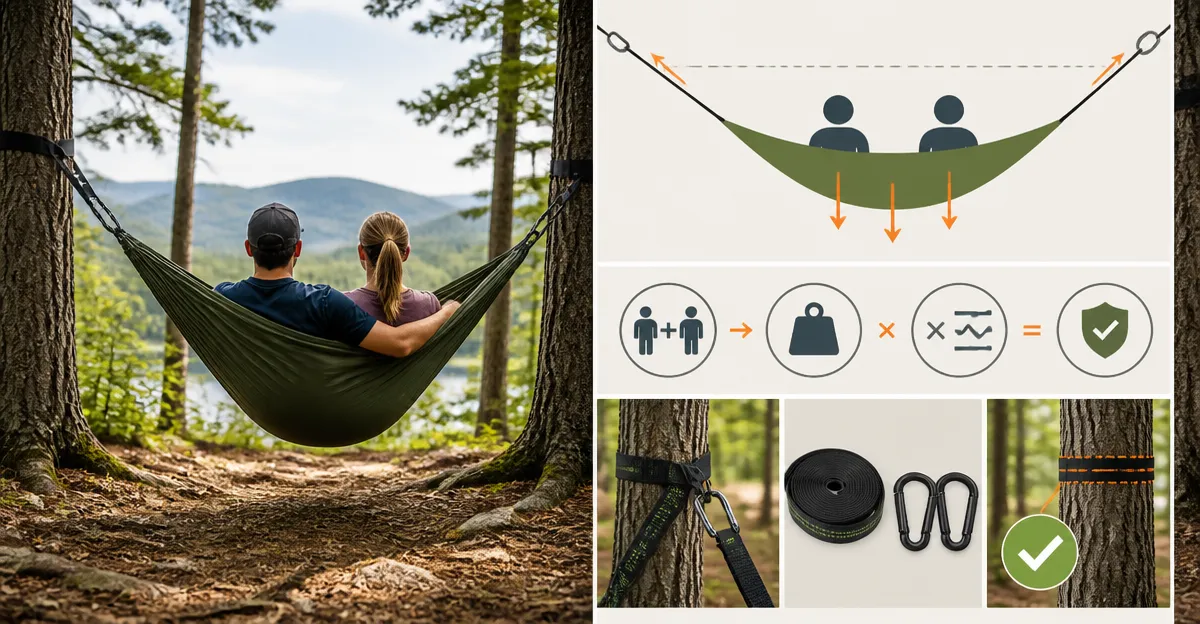
How to Calculate Hammock Suspension Load for Two People: Step‑by‑Step Guide to Safe Weight Capacity and Anchor Strength
In this guide the reader will learn how to determine the safe load for a two‑person hammock, how to select appropriate suspension straps, and how to verify that tree anchors can support the calculated weight. Understanding these principles prevents equipment failure, protects the surrounding environment, and enhances confidence while enjoying outdoor relaxation. The information presented is based on engineering fundamentals and real‑world experience from seasoned hammock users. By following the steps the reader will be able to set up a hammock system that is both safe and comfortable.
What You Will Need
- Two‑person hammock
- Tree‑friendly suspension straps (examples are ENO Atlas Hammock Straps, ENO Helios Hammock Straps, MalloMe Hammock Tree Straps, Foxelli XL Hammock Straps, or Onewind 12Ft Hammock Straps)
- Carabiners or attachment hardware (often included with the straps)
- Measuring tape or laser distance meter
- Scale for weighing occupants (optional but recommended)
- Notebook and pen for recording measurements
Step 1: Determine the Combined Occupant Weight
The first calculation requires the total weight of the two people who will use the hammock. If a scale is not available, each person can estimate weight based on recent measurements or known body mass. Add the two values together and record the result as the "combined occupant weight." For safety, add a 20 % margin to account for gear, clothing, and dynamic forces that occur when the hammock moves. For example, two occupants weighing 180 lb and 165 lb produce a combined weight of 345 lb; applying a 20 % safety margin yields a design load of approximately 414 lb.
Step 2: Select an Appropriate Suspension System
Choosing straps that can support the design load is critical. The ENO Atlas Hammock Straps are rated for 400 lb per strap and feature 30 attachment points, making them suitable for most two‑person configurations. Their 9 oz construction provides a balance of durability and low weight, and the wide webbing protects tree bark. The ENO Helios Hammock Straps, at 300 lb capacity per strap, are lighter (4.3 oz total) and include a compact storage bag, which is advantageous for backpacking where pack weight is a priority. MalloMe Hammock Tree Straps boast a 2000 lb capacity and 40 loops, offering exceptional flexibility for uneven tree spacing, though they are heavier at 14.99 USD. Foxelli XL Hammock Straps provide a combined 2000 lb capacity with a 20 ft total length, ideal for large clearings, and weigh only 0.66 lb, costing 13.77 USD. Onewind 12Ft Hammock Straps support 1500 lb per strap, include cinch buckles for fine tension adjustment, and weigh 0.7 lb at 17.90 USD. Based on the design load of 414 lb, any of these products meet the strength requirement, but the ENO Atlas or Helios straps are the most weight‑efficient choices for backpacking, while MalloMe or Foxelli provide extra capacity for heavy gear.
Step 3: Measure Anchor Distance and Height
Accurate measurement of the distance between the two anchor points is essential for determining the required strap length and tension angle. Use a measuring tape to record the horizontal distance between the selected trees at the height where the straps will be attached. Then measure the vertical distance from the ground to the intended attachment point on each tree. Record both values; they will be used in the trigonometric calculations that follow. For a typical two‑person hammock, a horizontal span of 12 ft and a vertical attachment height of 6 ft produce a comfortable 30‑degree suspension angle.
Step 4: Calculate Required Strap Length and Tension Angle
Apply the law of cosines to determine the length of each strap needed to achieve the desired angle. The formula L = √(D² + 2·H² – 2·D·H·cosθ) where D is the horizontal distance, H is the vertical height, and θ is the target angle (usually 30°). Using the example values D = 12 ft, H = 6 ft, and θ = 30°, the calculation yields a strap length of approximately 9.2 ft per side. Compare this result with the actual length of the selected straps. The ENO Atlas straps are 9 ft per strap, which is slightly short; the user may need to adjust the attachment height or choose a longer system such as the Foxelli XL straps (total 20 ft, 10 ft per side) to meet the geometry without excessive tension.
Step 5: Verify Tree Health and Load Distribution
Even the strongest strap cannot compensate for a weak or damaged tree. Inspect the bark for cracks, rot, or large limbs that could split under load. Choose trees with a diameter of at least 6 inches and a healthy canopy. When possible, wrap the strap around the trunk at least twice to increase friction and reduce stress on a single point. The wide webbing of the ENO Atlas and Helios straps distributes pressure over a larger surface area, minimizing bark damage. For trees with limited circumference, the MalloMe or Foxelli straps, with their multiple loops, allow the user to create a “double‑wrap” configuration that spreads the load.
Step 6: Install the Suspension Straps
Begin by looping each strap around the selected tree at the predetermined height. Use the daisy‑chain loops (ENO Atlas) or the micro‑tune system (ENO Helios) to select the appropriate attachment point that matches the calculated strap length. Secure the strap with a carabiner if the system includes one; otherwise, clip the strap directly to the hammock’s suspension points. Ensure that the strap is taut but not over‑stretched; a slight give is acceptable and helps absorb dynamic motion. The Onewind straps feature cinch buckles that allow fine‑tuning of tension without the need for knots, which is particularly useful for users who prefer a knot‑free setup.
Step 7: Test the System Before Use
Before climbing into the hammock, apply a static load equal to the design load. This can be done by attaching a weighted bag or by having one person sit in the hammock while the other gently pulls downward on the opposite side. Observe the straps for any slipping, excessive stretch, or deformation. Verify that the angle remains close to the target 30°; a steeper angle indicates insufficient length, while a shallower angle may cause excessive sag. If the system passes this test, the hammock is ready for regular use.
Tips & Pro Tips
- Always use tree‑friendly straps; wide webbing reduces bark damage and is often required by leave‑no‑trace principles.
- When hiking, select the lightest strap that meets the load requirement; the ENO Helios system weighs only 4.3 oz total.
- Carry a spare set of carabiners; a failure of a single connector can compromise the entire setup.
- For extreme weather, consider a strap with UV‑resistant coating; the Foxelli XL straps are triple‑stitched polyester that resists fading.
- Periodically re‑measure the tension angle after long trips, as strap stretch or tree movement can alter the geometry.
Troubleshooting
Problem: The hammock sags excessively even after tightening the straps.
Solution: Check that the attachment points are at the correct height; raising the anchor points reduces sag. If the straps are at their maximum length, consider switching to a longer system such as the Foxelli XL straps.
Problem: The strap slips off the tree during use.
Solution: Ensure the strap is wrapped at least twice around the trunk and that the selected loop is within the middle range of the daisy‑chain (ENO Atlas) or micro‑tune (ENO Helios). Adding a secondary knot for backup can provide additional security.
Conclusion
This guide has outlined a systematic approach to calculating hammock suspension load for two occupants, selecting suitable straps, measuring anchor geometry, and verifying safe installation. By applying the described calculations and following the recommended best practices, the reader can enjoy a reliable and comfortable hammock experience while protecting the surrounding environment. The principles presented are applicable to a wide range of hammock models and outdoor settings, ensuring long‑term safety and enjoyment.
Products Mentioned in This Guide
Frequently Asked Questions
How do I calculate the total suspension load for a two‑person hammock?
Add the combined weight of both occupants and the hammock, then multiply by a safety factor of 3 to determine the required load capacity.
What safety factor should I use when selecting suspension straps?
A minimum safety factor of 3:1 is recommended, meaning the straps should support three times the expected total weight.
Which type of suspension straps are best for protecting trees?
Tree‑friendly, wide webbing straps with spreader bars, such as ENO Atlas or Helios straps, reduce pressure on bark and prevent damage.
How can I verify that a tree anchor can support the calculated load?
Inspect the tree’s health, use a load‑cell or a calibrated rope pull tester, and ensure the anchor point can handle at least the calculated load with the safety factor applied.
What is the recommended maximum weight for most two‑person hammocks?
Most manufacturers rate two‑person hammocks for 400‑500 lb total, but always check the specific product’s rating and apply the 3:1 safety factor.