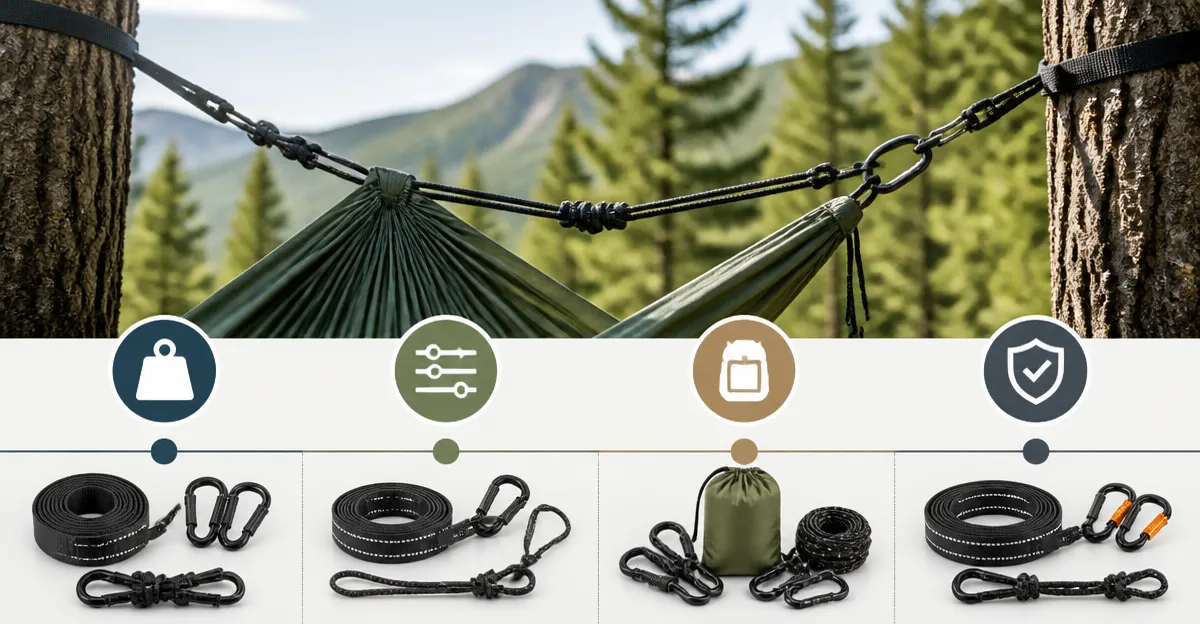
How to Compare Hammock Suspension Redundancy Kits: A Safety-First Guide to Strength, Setup, and Best Picks
This guide explains how one can evaluate hammock suspension redundancy kits with a focus on safety, durability, and ease of use. Readers will learn how to assess load capacity, tree‑friendly design, adjustability, and portability. The information is valuable for anyone who wishes to enjoy hammock relaxation without compromising personal safety. By the end of this article, one will be equipped to select the most appropriate kit for a given outdoor scenario.
What You Will Need
- Two sturdy trees or alternative anchor points spaced between 8 and 20 feet apart.
- A hammock compatible with tree straps (single, double, or parachute style).
- One or more of the recommended suspension kits.
- Carabiners (if not included with the kit).
- A small knife or scissors for trimming excess webbing.
All of the recommended kits include the essential components, so additional purchases are rarely required.
Step 1: Assess Anchor Point Compatibility
The first step is to verify that the trees or anchors can safely support the intended load. One should look for trees with a diameter of at least 4 inches and free of rot or large cracks. The anchor points must be able to accommodate the width of the strap without slipping. Using a kit with a wide, tree‑friendly strap reduces bark damage and complies with many park regulations.
For this evaluation, the ENO Atlas Hammock Straps provide a 9 oz, 9‑foot strap that distributes weight across a broad surface. Their 30 attachment points allow precise placement on trees of varying diameters, and the 400 lb capacity ensures ample safety margin for most users.
Key specifications:
- Weight capacity: 400 lb per strap.
- Length: 9 ft per strap.
- Attachment points: 30 loops.
- Price: $29.95.
- Rating: 4.9/5 from 3,589 reviews.
Choosing a strap with multiple loops simplifies the process of finding the optimal attachment height, especially when tree spacing is irregular.
Step 2: Determine Required Load Capacity
Next, calculate the maximum combined weight of the hammock, occupants, and any additional gear. A safety factor of at least 1.5 is recommended, meaning the straps should support 150 % of the calculated load. For two adults averaging 180 lb each, plus a 20 lb backpack, the total is 380 lb; a kit rated for at least 570 lb is advisable.
The MalloMe Hammock Tree Straps excel in this category, offering a combined capacity of 2,000 lb across two 12‑ft straps. Their reinforced triple stitching and no‑stretch polyester ensure that the load does not shift under dynamic movement.
Key specifications:
- Weight capacity: 2,000 lb total.
- Total length: 24 ft (12 ft per strap).
- Loops: 40 combined.
- Includes two locking carabiners and a storage bag.
- Price: $17.99.
- Rating: 4.8/5 from 10,727 reviews.
The high capacity makes these straps suitable for heavier hammocks, additional gear, or even a small swing attachment.
Step 3: Evaluate Adjustability and Loop Count
Adjustability determines how quickly one can achieve the ideal hang angle, typically between 30° and 35°. More loops provide finer granularity, reducing the need for repeated clipping and unclipping. When the distance between trees exceeds the strap length, the ability to wrap the strap around a tree multiple times becomes essential.
The Foxelli XL Hammock Straps offer two 20‑ft straps with 40 attachment loops plus two dedicated tree loops. Their extra length enables users to span distances up to 20 ft or create an “X” configuration for added stability.
Key specifications:
- Weight capacity: 1,000 lb per strap (2,000 lb total).
- Total length: 20 ft combined.
- Loops: 42 total.
- Weight: 0.66 lb (ultralight).
- Price: $12.97.
- Rating: 4.8/5 from 7,600 reviews.
The lightweight construction is advantageous for backpackers who prioritize pack weight without sacrificing strength.
Step 4: Consider Portability and Storage
Portability influences how easily the kit can be packed into a daypack or vehicle trunk. Compact straps that fold into a small pouch reduce bulk and protect the webbing from UV exposure. Some kits include dedicated storage bags, while others rely on the user’s own solution.
The Wise Owl Hammock Straps come with a carry pouch, two 10‑ft straps, and two carabiners, all fitting into a single lightweight bag. Their 38 loops provide sufficient adjustability for most tree distances while maintaining a compact profile.
Key specifications:
- Weight capacity: 500 lb combined.
- Length: 10 ft per strap.
- Loops: 38.
- Includes carabiners and pouch.
- Price: $23.99.
- Rating: 4.8/5 from 3,222 reviews.
For hikers who need to minimize gear volume, these straps strike a balance between strength and size.
Step 5: Choose Ultralight Options for Minimalist Backpacking
When weight is the paramount concern, ultralight straps reduce pack load while still offering reliable suspension. The trade‑off is often a lower weight capacity, making them suitable for solo users or light loads.
The ENO Helios Ultralight Hammock Straps are constructed from SilverLite cord and HMPE webbing, weighing only 4.3 oz per pair. They support up to 300 lb, which is adequate for a single adult with minimal gear.
Key specifications:
- Weight capacity: 300 lb total.
- Length: 8 ft 1 in per strap.
- Adjustment system: Microtune loops.
- Includes compact storage sack.
- Price: $34.95.
- Rating: 4.8/5 from 391 reviews.
The Microtune system eliminates the need for multiple clips, allowing rapid tensioning with a single adjustment.
Tips & Pro Tips
- Always inspect tree bark for cracks or rot before attaching any strap; damaged trees can fail under load.
- When possible, wrap the strap around the tree at least twice to distribute force and prevent slippage.
- Use a carabiner with a screw‑lock mechanism for added security, especially on longer excursions.
- For night camping, consider reflective stitching on straps to improve visibility.
- Maintain a consistent hang angle of 30°–35° to maximize comfort and reduce stress on the suspension system.
Troubleshooting
- Strap slipping off the tree: Re‑wrap the strap, ensuring the loop is positioned on the side opposite the hammock’s pull direction. Adding a second wrap around the trunk increases friction.
- Excessive sag under load: Move the attachment point higher on the tree or use a strap with additional loops to shorten the effective length.
- Difficulty achieving tension: Use the Microtune adjustment on the ENO Helios straps or the daisy‑chain loops on the ENO Atlas straps to fine‑tune without re‑clipping.
Conclusion
This safety‑first guide has outlined the critical factors for comparing hammock suspension redundancy kits, including load capacity, adjustability, tree‑friendliness, and portability. By following the step‑by‑step process, one can confidently select a kit that matches personal needs and environmental constraints. Selecting the appropriate kit not only enhances comfort but also ensures that hammock use remains a low‑risk activity for years to come.
Products Mentioned in This Guide
Frequently Asked Questions
What is a hammock suspension redundancy kit and why is it important?
It is a set of extra straps, carabiners, and connectors that provide backup support for a hammock, enhancing safety if the primary suspension fails.
How do I determine the load capacity needed for my hammock kit?
Calculate the total weight of users and gear, then select a kit rated at least 1.5‑2 times that amount for a safety margin.
Can I use a redundancy kit with any type of tree or anchor?
Yes, provided the anchor points are sturdy, have appropriate girth, and can accommodate the kit’s straps without damaging the tree.
What features make a redundancy kit tree‑friendly?
Tree‑friendly kits use wide, padded straps, avoid metal spikes, and distribute load to protect bark and cambium.
Is the redundancy kit portable enough for backpacking?
Most kits are lightweight and foldable, fitting into a small stuff sack for easy transport on hikes.