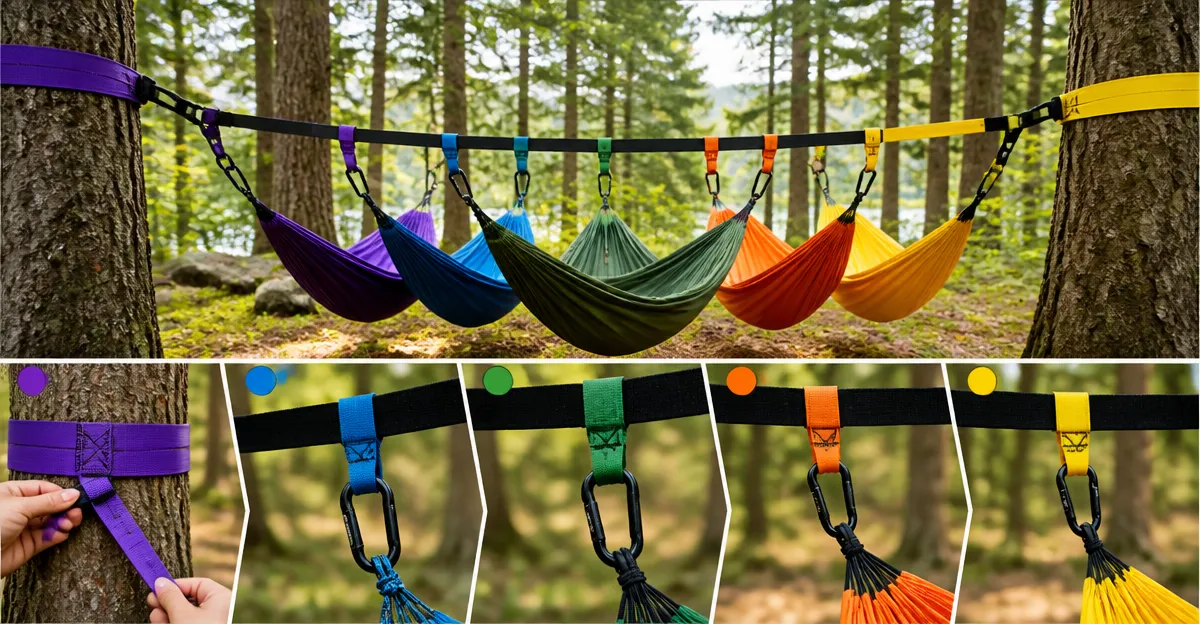
Introduction
One will discover how to design a color‑coded group hammock suspension system that reduces setup time and enhances safety. The guide explains the rationale behind color coding, the physics of load distribution, and the practical benefits of using high‑quality tree straps. Readers will gain confidence to assemble multiple hammocks for family camping, group retreats, or educational workshops. By following the instructions, one can create a repeatable system that minimizes mistakes and maximizes comfort.
What You'll Need
- Two Gold Armour XL Hammock Straps (20 ft total, 36 loops, 500 lb per strap)
- Two durable carabiners (included with the straps)
- Color‑coded zip ties or paracord loops (red, blue, green, yellow)
- Measuring tape (at least 25 ft)
- Tree protection sleeves or wide bark straps (optional but recommended)
- Portable camping hammock (single or double)
- Utility knife or scissors for trimming excess cord
Step 1 – Identify Suitable Anchor Points
One should begin by scouting two trees that are between 12 ft and 20 ft apart, with trunks of at least 6 in diameter. The trees must be healthy, free of rot, and have sturdy branches that can bear the combined load of the hammock and occupants. Measure the distance between the chosen anchor points with a tape measure; this measurement determines the placement of the color‑coded loops. Record the distance, because the next step involves adjusting the strap length to match the measured span.
Step 2 – Prepare the Gold Armour XL Hammock Straps
The Gold Armour XL Hammock Straps are constructed from 100 % no‑stretch polyester webbing, featuring triple‑stitched seams that prevent elongation under load. Each strap is 10 ft long and includes 18 loops, providing a total of 36 adjustment points. Because the straps are rated for 500 lb per strap (1 000 lb total), they are suitable for group configurations and heavy‑duty use. Unfold the straps, lay them flat on the ground, and inspect the carabiners for any signs of wear.
Step 3 – Implement Color‑Coding on the Loops
One should assign a distinct color to each loop that will correspond to a specific tension level or hammock position. For example, red loops can indicate the highest tension points, while green loops represent the lowest tension points. Use zip ties or short lengths of colored paracord to secure each loop; slide the tie through the loop and tighten it without cutting the webbing. This visual system enables rapid identification of the correct loop during setup, especially when multiple hammocks are being assembled simultaneously.
Step 4 – Attach the Straps to the Anchor Trees
Wrap each strap around the selected tree trunk, positioning the strap so that the loops face outward. Slide a carabiner onto a loop that matches the desired height, then clip the carabiner to the tree protection sleeve or directly to the bark if the tree is smooth. Because the straps are 1 in wide, they distribute pressure evenly, reducing damage to the bark. Repeat the process for the second tree, ensuring that both straps are parallel and at the same height.
Step 5 – Connect the Hammock to the Straps
Attach the hammock’s suspension lines to the colored loops that correspond to the recommended tension for the hammock model. Typically, a double‑parachute hammock requires a sag of approximately 30 % of the span; this translates to using loops that are three‑quarters of the way down the strap. Clip the hammock’s end loops into the selected colored loops using the included D‑shaped carabiners. Verify that the hammock hangs level by standing beneath it and checking for any tilt.
Step 6 – Adjust Tension and Verify Safety
One should now adjust the tension by sliding the carabiners up or down the colored loops until the hammock achieves the desired sag. The color‑coded system allows quick identification of the optimal loop without trial‑and‑error. After adjustment, pull down on the hammock with a weight equivalent to the maximum expected load (for a group of four, approximately 800 lb). Observe any stretch or movement; the Gold Armour straps will not elongate, ensuring that the hammock remains at a constant height. Finally, double‑check that all carabiners are locked and that the zip ties are secure.
Tips & Pro Tips
- Use tree protection sleeves to preserve bark and increase the lifespan of the straps.
- When setting up multiple hammocks, assign a unique color scheme to each hammock to avoid confusion.
- Carry a spare set of zip ties; they are inexpensive and can replace damaged loops quickly.
- Inspect the straps and carabiners before each outing; replace any component that shows fraying or corrosion.
- For night‑time setups, attach small reflective tape to the loops; this enhances visibility without affecting performance.
Troubleshooting
Problem: The hammock sags too low despite using the highest loops.
Solution: Verify that the trees are truly parallel; uneven anchor heights cause excessive sag. Re‑measure the distance and adjust the carabiners to higher loops.
Problem: The carabiner slips out of the loop under load.
Solution: Ensure that the loop is fully engaged and that the carabiner gate is closed. If slipping persists, move to a loop with a tighter radius.
Conclusion
One has learned how to create a color‑coded group hammock suspension system that streamlines setup, improves safety, and protects both trees and equipment. By selecting appropriate anchor points, employing the durable Gold Armour XL Hammock Straps, and applying a clear color‑coding scheme, one can assemble multiple hammocks quickly and confidently. The guide also provided practical tips, common‑issue solutions, and maintenance advice to extend the lifespan of the system. Readers are encouraged to practice the steps in a controlled environment before deploying the system on a full‑scale camping trip.
Products Mentioned in This Guide
Frequently Asked Questions
Why use a color‑coded system for multiple hammock suspensions?
Color coding instantly identifies each hammock’s anchor points and load limits, reducing setup errors and improving safety.
What are the recommended strap specifications for a group hammock system?
Use Gold Armour XL straps (20 ft total, 36 loops, 500 lb capacity) with durable carabiners for strong, reliable support.
How do I choose the right anchor trees for a group setup?
Select healthy trees with a diameter of at least 6‑8 in, spaced 10‑12 ft apart, and avoid roots or dead limbs.
Do I need tree protection sleeves, and why?
Yes—sleeves or wide bark straps protect tree bark from abrasion and distribute load, extending the life of both trees and straps.
What is the best way to maintain proper load distribution across multiple hammocks?
Attach each hammock to its own color‑coded strap at equal heights and tension, ensuring the combined load stays well below the strap’s 500 lb rating.