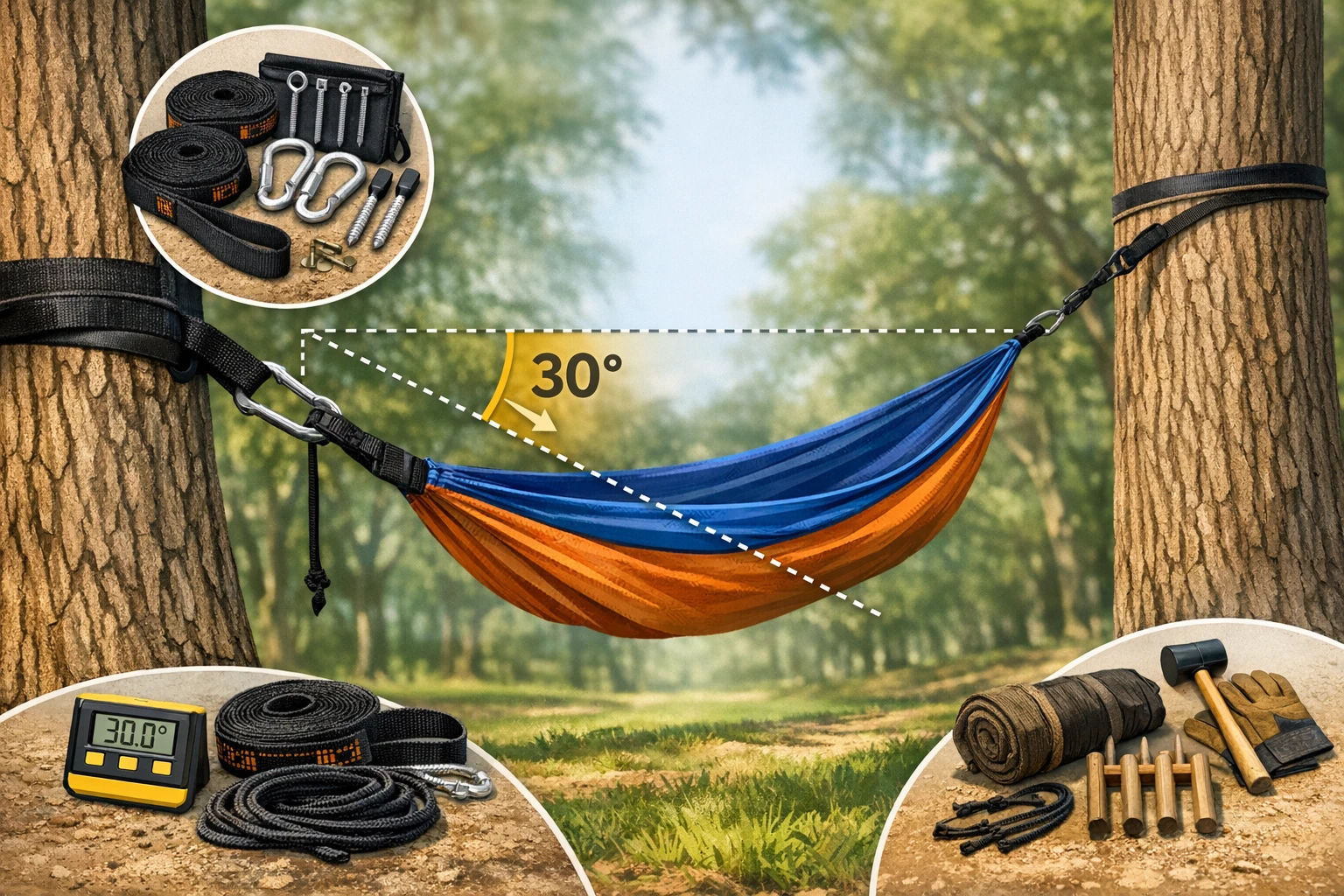
How to Hang a Hammock at the Correct Angle (The 30° Rule for Perfect Comfort & Safety)
One will discover how to achieve optimal comfort and safety by applying the 30° rule when hanging a hammock. This guide explains the physics behind the angle, describes the tools required, and provides a step‑by‑step process that any outdoor enthusiast can follow. By the end of the article, the reader will be able to set up a hammock that remains stable, reduces strain on the suspension points, and maximizes relaxation. The information is valuable for campers, backyard dwellers, and anyone who wishes to enjoy a hammock without risking damage to trees or equipment.
What You'll Need
- Two strong anchor points (trees, posts, or ceiling beams) spaced at least 12 feet apart.
- High‑capacity suspension straps such as MalloMe XL Hammock Straps.
- Optional ceiling‑mount hardware like the Morzejar Hammock Hanging Kit for indoor installations.
- Measuring tape, level, and a pencil for marking attachment points.
- Two carabiners (included with the MalloMe straps) for quick connection.
Step 1 – Select Appropriate Anchor Points
One should begin by identifying two anchor points that can support at least 2,000 pounds combined. Trees with a diameter of 4‑6 inches and healthy bark are ideal because they distribute load evenly. If trees are not available, sturdy posts or a ceiling beam that meets the load rating of the chosen hardware are acceptable alternatives. The anchor points must be positioned at a horizontal distance that allows the hammock to form a 30° angle when fully loaded.
Step 2 – Measure the Desired Height
The correct height ensures that the hammock hangs at the 30° angle while the user is lying flat. One can calculate the height by using the formula: Height = (Horizontal Distance ÷ 2) × tan(30°). For a 12‑foot span, the height from ground to attachment should be approximately 3.5 feet. Use a level to mark this height on each anchor point, making sure the marks are level with each other to prevent an uneven hang.
Step 3 – Install the Suspension Straps
Secure the MalloMe XL Hammock Straps around each anchor point. These straps are 12 feet long, 1 inch wide, and feature 20 attachment loops per strap, providing a total capacity of 2,000 pounds. The no‑stretch polyester webbing prevents sagging over time, even when wet, which is essential for maintaining the 30° angle. Fasten the included carabiners to the outermost loops, then clip the hammock’s end loops into the carabiners for a secure connection.
Step 4 – Adjust the Height and Tension
One should now tighten the straps by pulling the loops upward until the hammock reaches the previously marked height. The daisy‑chained loop system on the MalloMe straps allows fine‑tuning of the height without the need for knots, which saves time and reduces the risk of slippage. Verify the angle by standing directly under the hammock and measuring the angle with a protractor or a smartphone app; it should read close to 30°. If the angle is too steep, lower the attachment points slightly; if it is too shallow, raise them a few inches.
Step 5 – Test Load Capacity
Before regular use, one must test the system with a weight equivalent to the intended user. Place a sandbag or a weighted backpack on the hammock and observe any movement in the straps or anchor points. The MalloMe straps are designed to hold over 2,000 pounds, so they should exhibit no stretching or slipping under typical loads. If the hammock remains level and the straps stay taut, the installation is successful.
Step 6 – Optional Ceiling Installation
For indoor or porch setups where trees are unavailable, the Morzejar Hammock Hanging Kit provides a robust alternative. The kit includes a 360° swivel hook, stainless‑steel chain, and expansion screws suitable for concrete or wooden beams. Install the swivel hook into the ceiling using the supplied lag bolts, then attach the chain to the hammock’s loops. The 450 kg load capacity ensures safety, while the rotating design prevents twisting of the hammock during use.
Tips & Pro Tips
- Always inspect the bark of trees for rot or disease before wrapping straps; damaged bark can reduce load capacity.
- Use a reflective stitching option on straps if night use is anticipated; this improves visibility and safety.
- When hanging near a water source, select straps with UV‑resistant coating to extend lifespan.
- Consider adding a small weight to the hammock’s center to maintain tension and prevent excessive sag.
Troubleshooting
Problem: The hammock sags excessively after a few hours of use.
Solution: Verify that the straps are not stretched; replace any strap that shows signs of elongation. Re‑measure the attachment height and adjust the loops to raise the hammock slightly.
Problem: The anchor point rotates or shifts under load.
Solution: Reinforce the anchor by adding a protective sleeve of rope around the tree trunk before attaching the strap. This distributes pressure and prevents the strap from cutting into the bark.
Conclusion
One now possesses a complete understanding of how to hang a hammock at the correct 30° angle, ensuring both comfort and safety. By selecting strong anchor points, using high‑quality suspension hardware such as the MalloMe XL Hammock Straps or the Morzejar Hammock Hanging Kit, and following the precise measurement and adjustment steps, the reader can enjoy a stable and relaxing hammock experience. Remember to test the system before regular use and to perform periodic inspections to maintain safety over time.
Products Mentioned in This Guide
Frequently Asked Questions
What is the 30° rule when hanging a hammock?
The 30° rule means the hammock should form a 30‑degree angle with the ground at each end, providing optimal comfort and reducing strain on anchor points.
How far apart should anchor points be for a standard hammock?
Anchor points should be at least 12 feet apart to allow the correct sag and maintain the 30° angle.
Can I use regular rope instead of hammock straps?
While rope works, high‑capacity hammock straps are recommended because they distribute load evenly and protect tree bark.
Do I need a level when setting up a hammock outdoors?
A level helps verify the 30° angle, but you can also use a simple string and protractor method to check the slope.
Is the 30° rule applicable for indoor ceiling‑mounted hammocks?
Yes; the same angle ensures safe load distribution on ceiling beams and maximizes comfort inside.