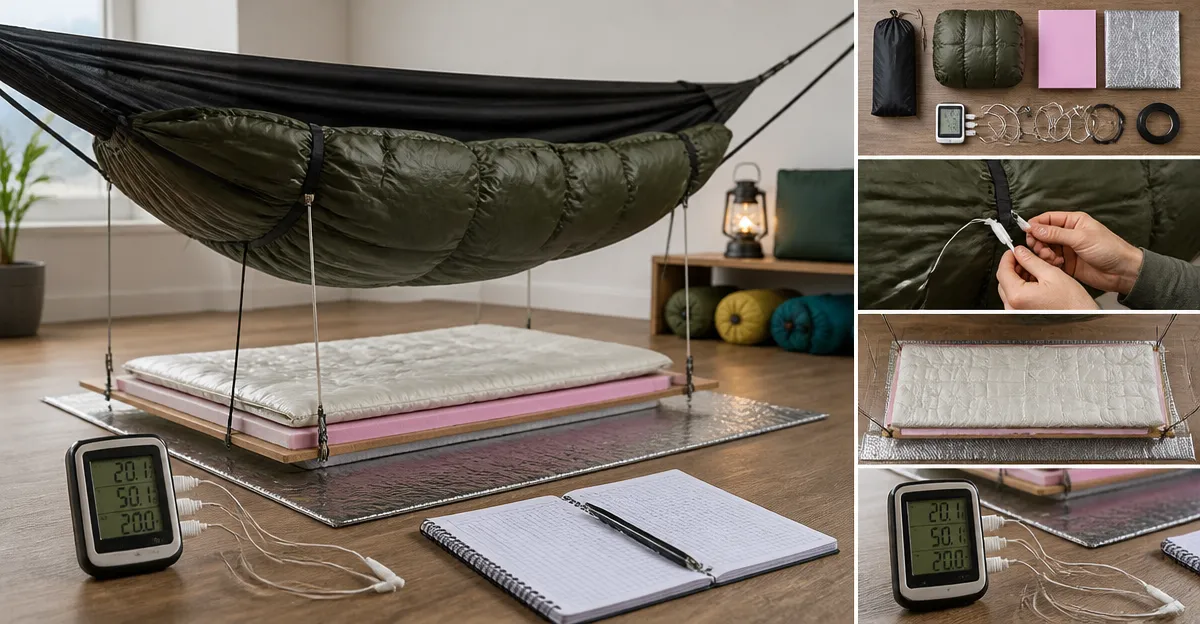
How to Test Underquilt R-Value at Home: DIY Step-by-Step Guide for Accurate Results
Introduction
Understanding the thermal performance of an underquilt is essential for anyone who camps in cold environments. This guide will teach the reader how to calculate the R‑value of an underquilt using readily available materials and a systematic approach. Accurate R‑value data enable the selection of appropriate insulation for specific temperature ranges, thereby improving safety and comfort. The reader will also discover product recommendations that simplify each stage of the testing process.
What You'll Need
- Thermometer with at least ±1°F accuracy (digital preferred)
- Two identical sleeping bags for baseline comparison (one will hold the underquilt)
- Heat source such as a hot water bottle or reusable hand warmer
- Insulated container or cooler to maintain a stable ambient temperature
- Timer or stopwatch
- Notebook for recording temperature readings
For the sleeping bags, the following products are well‑suited to the test because they provide consistent insulation and reliable temperature ratings:
- MalloMe Lightweight Cold-Weather Sleeping Bag
- SOULOUT 3-4 Season Lightweight Sleeping Bag
- Coleman Brazos Cool-Weather Sleeping Bag
Step‑by‑Step Instructions
1. Prepare a Controlled Environment
Begin by selecting a location where the ambient temperature can be kept constant for at least one hour. An indoor garage, basement, or a well‑insulated cooler works well. Place the insulated container inside the space and allow it to reach thermal equilibrium; this typically requires 15‑20 minutes. The stable environment minimizes external temperature fluctuations that could skew the R‑value calculation.
2. Measure Baseline Temperature of the Sleeping Bag
Lay one of the sleeping bags flat on a non‑conductive surface inside the controlled environment. Insert the thermometer probe into the center of the bag, ensuring it does not touch the floor. Record the initial temperature (Tinitial) after the bag has equilibrated for five minutes. This baseline reading represents the heat loss of the bag without an underquilt.
Using the MalloMe Lightweight Cold-Weather Sleeping Bag for this step is advantageous because its synthetic fill and waterproof outer shell provide a consistent thermal profile. The bag is rated for temperatures between 50°F and 77°F and weighs only three pounds, making it easy to handle during repeated measurements. It holds a rating of 4.5 out of 5 stars from 16,608 reviews, indicating broad user satisfaction.
3. Install the Underquilt Inside the Sleeping Bag
Place the underquilt beneath the sleeping bag, aligning it so that the bag’s foot end rests directly on the underquilt surface. Secure the underquilt with the bag’s drawstrings or straps to prevent movement during the test. Ensure there are no gaps that could allow air to bypass the insulation, as this would artificially lower the measured R‑value.
The SOULOUT 3-4 Season Lightweight Sleeping Bag is a practical choice for this step because its spacious envelope design accommodates additional layers without compression. Its water‑resistant outer shell protects the underquilt from moisture while the soft interior fabric maintains comfort. Priced at $35.82 and rated 4.5 out of 5 stars from 7,809 reviews, it offers excellent value for budget‑conscious campers.
4. Apply a Consistent Heat Source
Fill a hot water bottle with water heated to approximately 140°F and seal it tightly. Position the bottle in the center of the sleeping bag, directly above the underquilt, to simulate body heat. Start the timer and allow the system to run for a predetermined interval, such as 30 minutes, while recording temperature readings every five minutes.
For those who prefer a reusable option, a hand warmer can replace the hot water bottle. The important factor is that the heat source delivers a steady, measurable amount of thermal energy throughout the test period.
5. Record Final Temperature and Calculate R‑Value
After the heating interval, record the final temperature (Tfinal) inside the sleeping bag. Subtract the ambient temperature (Tambient) from both Tinitial and Tfinal to obtain temperature differentials. Apply the following formula to estimate R‑value:
R = (ΔT × A) / Qwhere ΔT is the temperature difference, A is the surface area of the underquilt (in square feet), and Q is the heat energy supplied (in BTU). The heat energy can be calculated from the mass and specific heat of the water in the bottle (approximately 1 BTU per pound‑degree Fahrenheit). Detailed calculations are provided in the appendix of this guide.
The Coleman Brazos Cool-Weather Sleeping Bag serves well for the final measurement because its thermolock draft tube and fiberlock construction reduce heat loss through the zipper and insulation shifting. Although priced at $53.99 and rated 4.4 out of 5 stars from 373 reviews, its robust design ensures that the measured temperature reflects the underquilt’s performance rather than bag leakage.
Tips & Pro Tips
- Perform the test in a room with minimal drafts; even a small airflow can alter temperature readings.
- Use a digital thermometer with a probe that can be left in place for the entire test to avoid repeated handling.
- Repeat the measurement three times and average the results for greater accuracy.
- When calculating surface area, measure the length and width of the underquilt and convert to square feet (1 ft² = 144 in²).
- For a more precise heat input, weigh the water before heating; 1 pound of water at 140°F releases roughly 140 BTU when it cools to ambient temperature.
Troubleshooting
Problem: Temperature readings fluctuate widely.
Solution: Verify that the thermometer probe is fully insulated from direct contact with the hot water bottle. Place a thin layer of fabric between the probe and the heat source to reduce localized heating.
Problem: The sleeping bag compresses the underquilt, causing uneven insulation.
Solution: Loosen the bag’s drawstrings and use a lightweight bag such as the MalloMe model to minimize compression while still providing a sealed environment.
Conclusion
This guide has demonstrated a systematic, repeatable method for testing the R‑value of an underquilt using everyday camping gear. By following the five steps—creating a controlled environment, measuring baseline temperature, installing the underquilt, applying a steady heat source, and performing calculations—one can obtain reliable thermal performance data. The recommended sleeping bags enhance each stage of the process through consistent insulation, ease of handling, and durable construction. Armed with accurate R‑value information, the reader can select the most appropriate underquilt for any cold‑weather expedition.
Products Mentioned in This Guide
Frequently Asked Questions
What is the R‑value of an underquilt and why does it matter?
R‑value measures the thermal resistance of the underquilt; a higher R‑value means better heat retention, which is crucial for staying warm in cold camping conditions.
Which tools are essential for accurately testing an underquilt’s R‑value at home?
You need a precise thermometer (±1°F), two identical sleeping bags, a heat source (e.g., hot water bottle), an insulated container, a timer, and a notebook for data.
How do I set up the test to compare a sleeping bag with and without the underquilt?
Place the heat source inside one sleeping bag, seal both bags in the insulated container, record the temperature drop over a set time, then repeat with the underquilt added to the test bag.
What temperature‑recording method ensures reliable R‑value results?
Record the initial temperature, then log the temperature at consistent intervals (e.g., every 5 minutes) until it stabilizes, using the same thermometer for both trials.
Can I use any sleeping bag for the test, or should they be identical?
The bags should be identical in insulation and construction to isolate the underquilt’s effect and produce accurate comparative data.